Image


As the world celebrates the International Year of the Woman Farmer, Nyirahabimana Vestine's journey highlights how access to knowledge, collective action, and economic opportunities can help rural women become leaders in transforming agriculture and their communities.
Nyirahabimana Vestine is a rural woman and mother of four from Giseke Village, Cyamukuza Cell, Ndora Sector, Gisagara District. She is a member of Urumuri Cyamukuza Cooperative, which grows maize and vegetables such as peppers and eggplants. Before joining the JP RWEE in 2024, she supported her family through a mix of crop farming, raising livestock and small-scale trading.
Although she earned income from both her own farm and the cooperative, the returns were modest. Because the income from her activities was pooled together without any record-keeping, she could never tell whether she had made a profit or a loss by the end of the year. With limited knowledge of financial management, she struggled to track household resources or assess the results of her work. She also kept mostly to herself and rarely interacted with others in the community. Seeing little improvement in her family’s situation, she accepted these challenges as a normal part of rural life.
Nyirahabimana started participating in community activities with the JP RWEE training on Gender Action Learning System (GALS) and engaged in discussions with fellow cooperative members. With the training, she learned the importance of setting goals, keeping financial records, and planning investments to improve household finances. Inspired by what she learned, Nyirahabimana shared the training with her husband so they could begin making household decisions together.
The couple developed a shared vision for their family's future. Instead of mixing income from farming, livestock, and trade, they began keeping separate records for every activity, allowing them to understand which enterprises generated the greatest returns and where they should invest more.
The knowledge she gained was reinforced through learning alongside other women farmers in the cooperative, where members encouraged one another to adopt better farming and financial practices.
"We could cultivate a large field and hire workers, but the year would end without knowing whether we had progressed or lost money. The training completely changed the way we think."
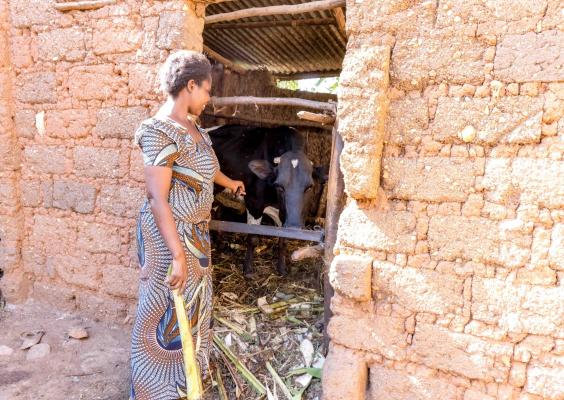
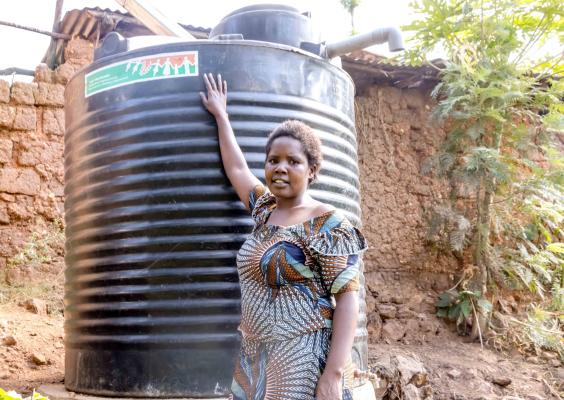
1 - Nyirahabimana standing beside one of her dairy cows, an investment made possible through better household planning and improved financial management. @FAO Rwanda/Christian Ngabonziza I 2 - Nyirahabimana beside the household water tank installed through improved investments and planning, reflecting the family's growing resilience and improved living conditions. @FAO Rwanda/Christian Ngabonziza
Collective action opens new opportunities
Through the cooperative's goal-oriented savings activities, Nyirahabimana and her husband set ambitious but realistic goals. Their first objective was to save enough money to purchase a motorcycle for her husband to earn additional income as a motor taxi driver, and also make it easier to transport their harvest to market. Working together and following the financial discipline learned through JP RWEE, they achieved that goal within two years. Soon afterward, they reached another milestone by purchasing additional land for farming.
One of the most significant changes was learning how to use loans provided by the Village Savings and Loan Association (VSLA) productively. Previously, loans were often spent on household consumption, making repayment difficult. Today, every loan is invested in income-generating activities supported by careful planning and proper bookkeeping. Moreover, Nyirahabimana started providing training to her cooperative members on how to use money to improve their households.
This financial discipline has strengthened the family's resilience while demonstrating to other cooperative members how collective learning can translate into lasting economic gains.
Becoming a leader in climate-smart agriculture
The knowledge gained through JP RWEE also transformed Nyirahabimana's farming practices. She learned proper crop spacing, improved seed selection, and better farm management techniques that significantly increased productivity of maize and bell peppers and eggplants, even during challenging weather conditions.
"Before, I could harvest about 200 kilograms per hectare and think I had done well. Now, after learning proper spacing and improved practices, I can harvest up to one tonne, even during drought."
Her outstanding results attracted the attention of the Rwanda Agriculture and Animal Resources Development Board (RAB), which selected her as a model farmer to participate in research and the multiplication of foundation seed, and provided the seeds. Today, farmers across her community purchase high-quality maize and vegetable seed from her, recognizing both her technical knowledge and commitment to improving agricultural production.
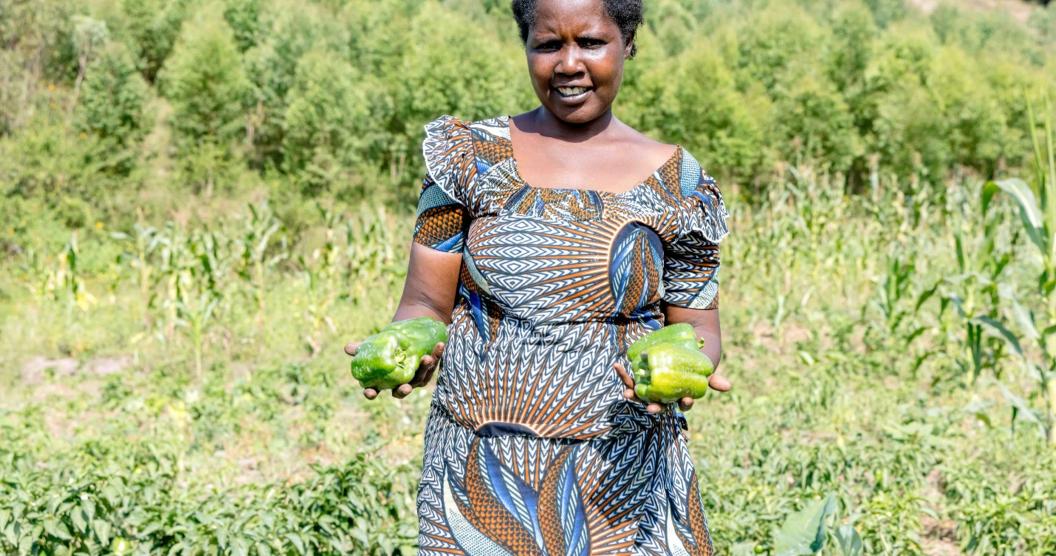
Nyirahabimana proudly displays some of the high-quality bell peppers produced using improved agricultural practices. @FAO Rwanda/Christian Ngabonziza
Stronger together
For Nyirahabimana, the greatest transformation extends beyond higher yields and increased income. By participating actively in her producer cooperative, farming together, learning together, and saving together with other members, she gained confidence, strengthened her leadership, and became someone other farmers now look up to for guidance. Now she also shares knowledge with her family and neighbors, and she has become a catalyst for change in her community.
She believes even greater progress can be achieved when both women and men participate together in household development.
"When both husband and wife receive the training, they share the same vision for their family's future. They make decisions together, and the household develops much faster."
Nyirahabimana's journey demonstrates that lasting transformation begins with knowledge, grows through collective action, and flourishes when women are empowered to lead. Today, she is not only improving her own family's future but also helping other farmers adopt better practices, strengthening food security and resilience across her community.