Image


Levelling the playing field in agrifood systems and ensuring that women and men have access to equal opportunities is a precondition for achieving zero hunger worldwide. The Joint Programme on Rural Women's Economic Empowerment (JP RWEE) brought together champions of women's empowerment at the 53rd Session of the Committee on World Food Security to discuss how progress can be accelerated towards a more equitable future in agrifood production. The event, “From Policy to Action: Investing in Women for a Just Agrifood Systems Transformation” was hosted by the Food and Agriculture Organization of the United Nations (FAO) and the World Food Programme (WFP) on behalf of the programme, and co-hosted by Ireland, Sweden, Switzerland, the International Fund for Agricultural Development (IFAD) and the United Nations Programme for Gender Equality and the Empowerment of Women (UN Women).
Government representatives from Ireland, Switzerland, Tunisia, the United Republic of Tanzania, as well as the Civil Society and Indigenous Peoples’ Mechanism (CSIPM), took part of the discussion, bringing diverse perspectives on what meaningful investment in rural women looks like in practice.
The event provided a dedicated space for Governments, Civil Society, UN agencies implementing the JP RWEE, and other stakeholders to explore how strategic investments and partnerships in agrifood systems can advance gender equality, empower rural women and promote food security and nutrition in line with the recommendations of the CFS Voluntary Guidelines on Gender Equality and Women’s and Girls’ Empowerment in the Context of Food Security and Nutrition (VG-GEWGE).
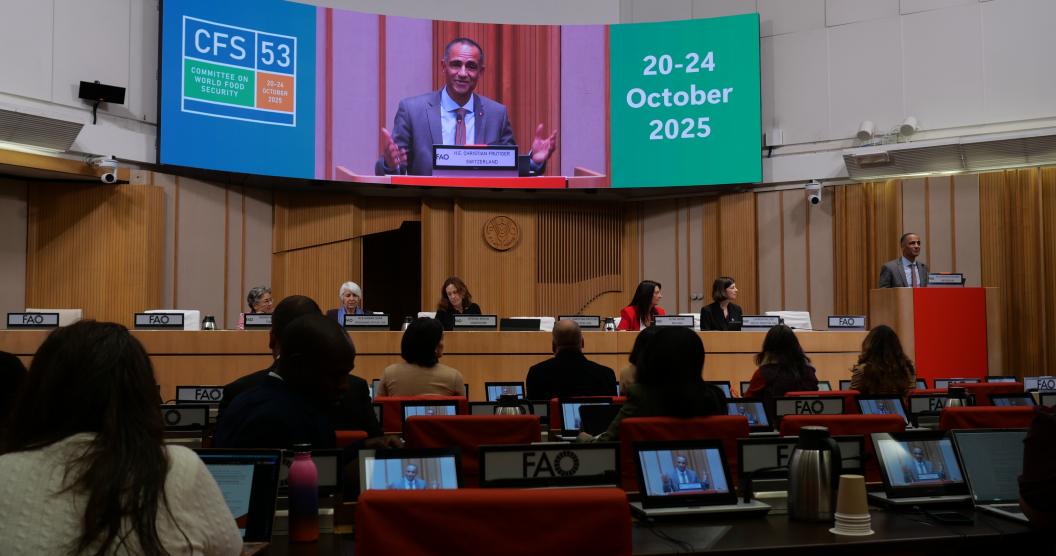
H.E. Ambassador Christian Frutiger speaking at the event in front of the auditorium. Photo: FAO/Silvia Vilimelis Lopez
In his opening remarks, H.E. Ambassador Christian Frutiger, Head of Delegation and Assistant Director-General, Swiss Agency for Development and Cooperation, highlighted how “Investing in women is investing in the transformation of our food system and in the future of sustainable development. Today's theme - from policy to action - is both timely and urgent. Around the world, women are the backbone of food systems. Evidence is clear. When women have the same access to productive resources as men, farm yields increase by up to 30 percent”.
Brenda Behan, Director of Gender, Protection & Inclusion at WFP, opened the discussion by inviting panelists and participants to consider how the VG-GEWGE and the JP RWEE can serve as complementary tools to accelerate agrifood systems transformation.
One example includes the Programme to Promote the Uptake and Dissemination of the VG-GEWGE, launched in January 2025 as part of FAO's efforts to translate the guidelines' recommendations into action, which was showcased by Alejandra Safa Barraza, Global Programme Coordinator, at the event.
Hela Hassine Rezgui, Director of the Rural Women's Support Office at the Ministry of Agriculture in Tunisia, highlighted how the JP RWEE has begun translating principles of gender equality into everyday practices.
She emphasized that JP RWEE activities demonstrate real progress in strengthening women’s autonomy, backed by strong institutional support; and that this alignment with national priorities is key to long-term sustainability.
Mondy Muhando, Director of the Blue Economy Development and Coordination Department from the United Republic of Tanzania, Zanzibar, shared how the programme has catalyzed change: “It's not just an implementation to get the outcomes that are set for the programme. It's been shaping a movement, and this movement has proven that when rural women are equipped with rights, resources, and they're recognised, they do not just participate, they take lead”. Her intervention highlighted how reforms in land rights, access to resources and climate-resilient livelihoods are already showing promising results.
Elisa Goode, Assistant Principal Officer from the Department of Agriculture, Food and the Marine, outlined Ireland’s long-standing investment in gender equality as both smart economics and sound policy: “By investing in women, we are investing in stronger families, more productive farms, and more resilient communities. It's not just good economics, but it's actually good common sense”. She provided insight into Ireland’s policy reforms, targeted investments, and gender-responsive budgeting practices that have supported women farmers and women-led enterprises.
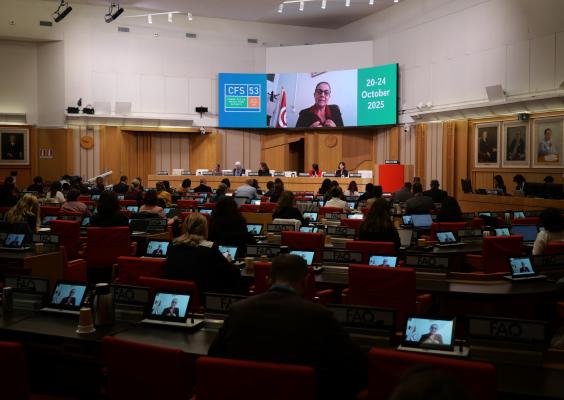
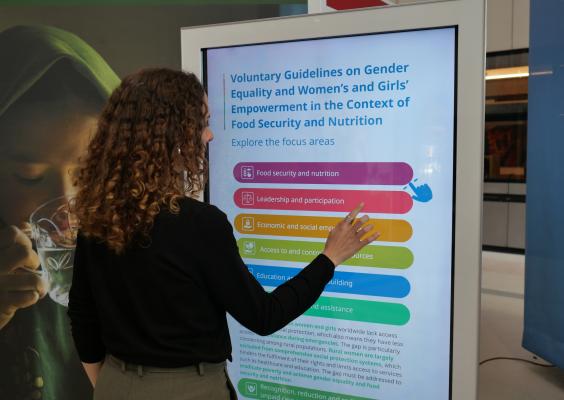
1. Hela Hassine Rezgui speaking at the event online in front of the auditorium. 2. A person is selecting one of the VG's focus areas on a touch screen. Photos: FAO/Silvia Vilimelis Lopez
Closing the panel, Souad Mahmoud, World March of Women & CSIPM Coordination Committee member for the women’s constituency from Tunisia and the North African region, offered a powerful reminder of the role of women at the center of transformation: “We all know that equality is not decreed, it is achieved. And this achievement begins when rural women, with their words, their knowledge and their strength, become the real actors of social transformation”.
In her closing reflections, Lauren Phillips, Deputy Director of FAO’s Rural Transformation and Gender Equality Division highlighted interlinkages of different initiatives “If you look carefully through programmes like the JP RWEE, the Guidelines, and Commit to Grow Equality, you can see these lines running through - on the importance of working to address critical gaps of gender equality, on productivity, on wages, and around norms and policies which need to be enabling.”
Building on the momentum of the event, the JP RWEE will continue to work jointly with FAO and other partners to:
As the discussions made clear, investing in women is not only essential but it is transformational. The event reaffirmed that with political will, targeted investment and strong partnerships, policy frameworks can shift from paper to practice and deliver meaningful change for rural women around the world.
See the recording of the event here.