Image


In many communities, women bear a disproportionate burden of unpaid care work, limiting their economic participation and withholding their potential. Daily, women in Tanzania shoulder most childcare, cooking, and household responsibilities. That cycle not only limits their growth opportunities but also perpetuates entrenched gender inequalities.
In Zanzibar, women spend 87 percent of their time on unpaid domestic and care work compared to males, who spend 13 per cent of their annual time in the same work. Similarly, in mainland Tanzania, women devote 3.7 times more of their time to unpaid care and domestic work than men, thus having less time to engage in productive work or other activities.[1]
According to October 2022 JP RWEE baseline data measured using the Project-Level Women’s Empowerment in Agriculture Index, men in Tanzania spend an average of 1.6 hours per day on unpaid care and domestic work, whereas women in dual households spend an average of 6.85 hours daily on these tasks, highlighting the significant gender disparity in household responsibilities.
Recent baseline survey findings from the three districts where the Joint Programme on Rural Women's Economic Empowerment (JP RWEE) works confirmed those statistics. In Dodoma, women spend five hours a day on childcare alone; in Singida, it's six hours a day, and in South Unguja, it's 3.6 hours. Addressing women's disproportionate burden of unpaid care and domestic work is crucial to enabling women to engage in economic activities fully and promoting gender equality.
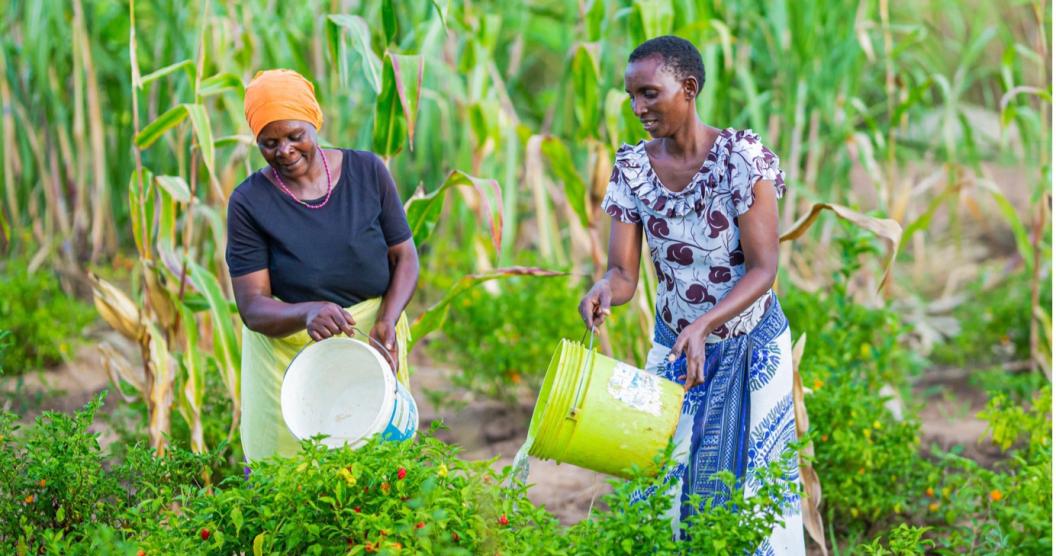
Two women water crops in a field. Photo: WFP/Tanzania
Recognising this challenge, JP RWEE partners designed targeted interventions to address women's distribution of unpaid care work. The activities include sensitising local government authorities, wards, village and community leaders, and male and family gender champions using SASA[2] and RESPECT[3] tools.
Those initiatives are designed to prevent economic violence and promote women's access and ownership of productive resources and equitable distribution of unpaid care work to be able to engage in climate-smart agriculture as well as development materials to sensitise communities and local government institutions to have a greater understanding and knowledge of women's disproportionate unpaid care work burden and the 3Rs (reduce, redistribute and recognise unpaid care work). JP RWEE partners reached over 19,000 rural women and men through those efforts by 2023.
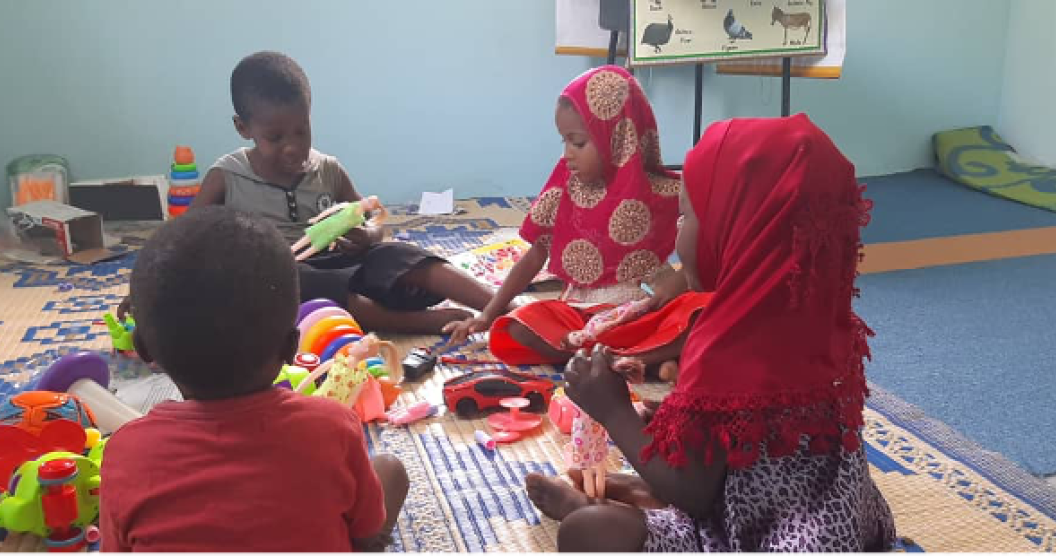
Children play with toys at a childcare centre in Zanzibar, while their mothers engage in economic activities elsewhere. Photo: WFP/Tanzania
The programme forged partnerships with public and private sector institutions to complement those efforts to reduce women's time spent on unpaid care work. One of the most pressing issues addressed was the lack of accessible and affordable childcare services. For many women, the absence of reliable childcare options forces them to juggle caregiving responsibilities alongside their economic activities, constraining their ability to engage in income-generating activities fully. That problem not only perpetuates the cycle of poverty but also perpetuates gender disparities in the workforce.
In Zanzibar and Singida, JP RWEE partners worked with local governments to establish childcare centers within communities. In Zanzibar, through repurposing a former pre-primary school and securing the support of the local sheha[4], JP RWEE created a safe and nurturing environment where women can entrust their children. At the same time, they can pursue economic opportunities such as seaweed farming.
In Singida, the Ikungi District Council and community members repurposed former shop stalls to host a childcare center. The services of both centres, with a capacity of 50 children each, are in high demand.
Discussions are underway for parents to contribute a modest fee to compensate caregivers, provide meals, and maintain the facility. Moreover, JP RWEE and its partners are actively engaging with the local government and community to devise long-term sustainability plans for these centres.
The childcare centre offers a lifeline for parents like Hadah Ameir and Nodra Abdalla, seaweed farmers targeted by the JP RWEE. They recount the struggles of forgoing income-generating activities due to the need for childcare options on certain days, which means they missed crucial seaweed farming timelines.
"The childcare centre is a blessing for us. We can now work knowing our kids are safe. It's like a weight off our shoulders, giving us hope knowing our children are in a safe environment," said Hadah, a mother of eight children in Zanzibar.
In Ikungi, one male community member highlighted the need for more centres to cater to the significant demand that the new childcare centre garnered. "The center can only host 50 children but so far more than 50 parents turned out to register their children for a slot at the center despite the fact that a fee has to be paid. This shows how much demand these centres have; we really wish there were more of these within the community."
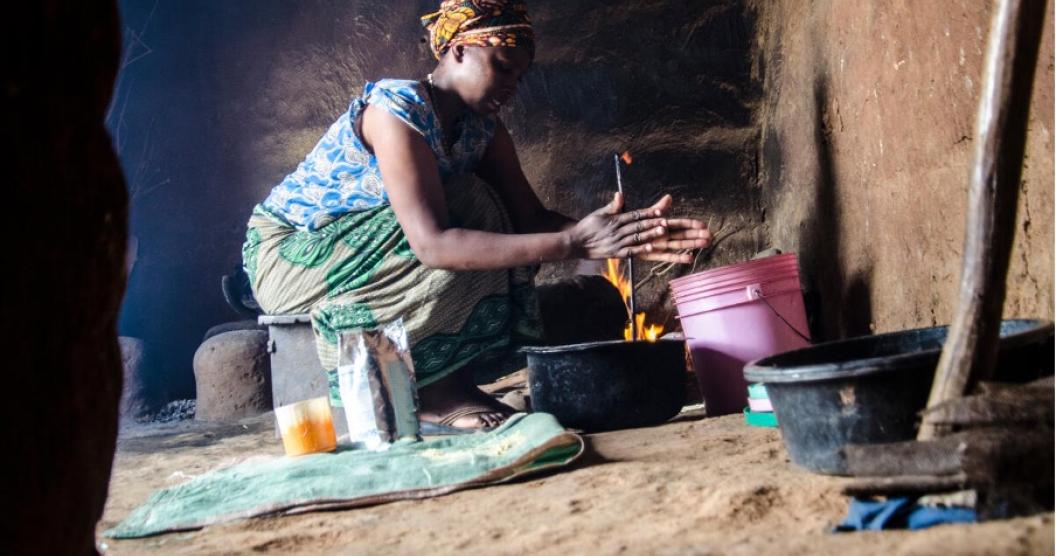
A woman prepares a meal in her home. Photo: WFP/Tanzania
Furthermore, the JP RWEE is collaborating with private sector companies and governmental agencies to address another critical aspect of women's unpaid care work: the time spent on cooking.
Sitti Amour and Fatuma Mohamed Abaass, both horticulture farmers in Zanzibar, attest that they no longer have to compete for time between cooking and performing their economic activities. "In the past, I would have to spend several hours cooking, and looking for firewood was another chore I had to juggle with, adding more time to the meal preparation process,' says Sitti."
Through a strategic partnership with Orxy Energies and the Zanzibar Utilities Regulatory Authority, rural women in Zanzibar have received subsidised gas cooking cylinders/stoves and comprehensive training on usage, empowering women to adopt more efficient and sustainable cooking practices, reducing a lot of time spent cooking. As a result, Oryx Energies provided 335 gas cylinders with a cooking plate to 335 women at a subsidised price of TZS 5000.00 (USD 1.93) instead of TZS 45,000 (USD 17.41) for a new gas cylinder and provided a free first refill. This strategic partnership reduces the time spent on cooking and promotes healthier and more sustainable cooking practices, enhancing the overall well-being of women and their families.
To build on its current successes, the JP RWEE plans to expand its childcare centre network and explore additional time-saving technologies for household tasks. Future initiatives will focus on scaling up partnerships with private and public sectors, ensuring sustainable support, and continuing community sensitisation efforts to foster long-term gender equality and economic empowerment for women across Tanzania.
To learn more about the SASA! approach and access its resources, you can visit the SASA! Together page on Raising Voices
For information on the RESPECT framework, which is a set of action-oriented steps developed by WHO to prevent violence against women, you can refer to the WHO's RESPECT Women framework page.
[1] International Labour Organization; Tanzania: Gender-Responsive Public Works as a Key Building Block of Social Protection for All. Available at https://www.ilo.org/wcmsp5/groups/public/---ed_emp/documents/publication/wcms_675197.pdf
[2] SASA! means "now" in Kiswahili and is an acronym for the approach's four phases: start, awareness, support, and action. While SASA! has evolved over time, its core components remain consistent. It supports organisations and communities in exploring concepts of power, violence, and safety.
[3] A framework for preventing violence against women.
[4] Sheha is a local administrative leader or chief appointed to oversee a specific regional area or ward. They serve as government representatives at the grassroots level and play an essential role in community affairs, including governance, dispute resolution, and local development initiatives.